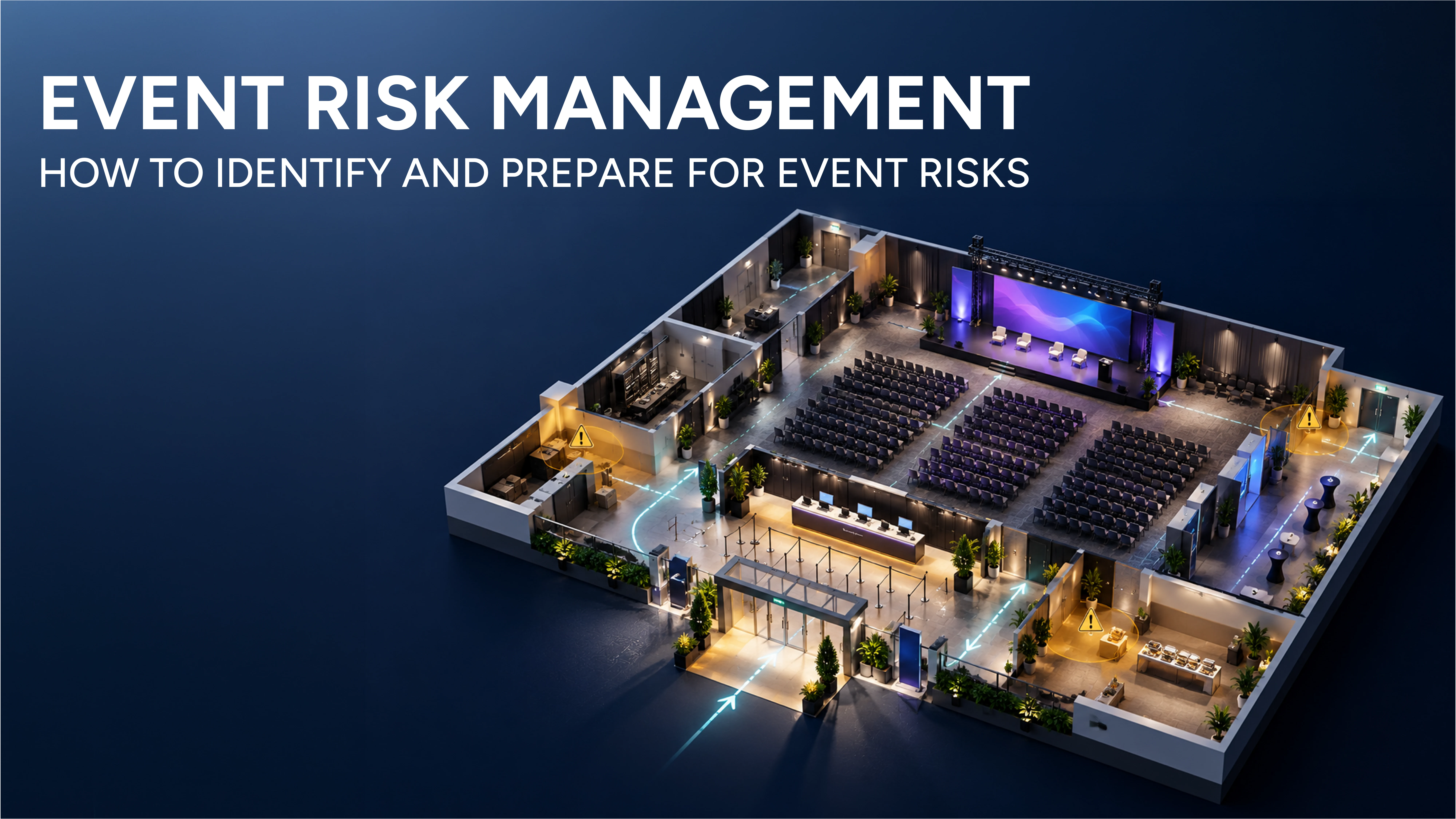
Events, whether it’s a corporate conference, trade show, concert, or hybrid event, always come with uncertainties. A sudden weather change, technical issue, vendor cancellation, or security problem can disrupt even the best-planned event within minutes. These unexpected situations can affect attendee experience, revenue, operations, and brand reputation.
That’s why having a strong event contingency plan is critical for modern event management. Effective contingency planning for events helps organizers prepare for risks, respond faster during emergencies, and minimize disruptions when unexpected situations occur. Instead of scrambling during a crisis, a well-structured backup plan for events gives your team a clear process to follow.
A solid contingency plan event management strategy also improves communication, protects attendee safety, and ensures business continuity during technical failures, venue issues, or weather disruptions. Whether you’re managing an in-person, virtual, or hybrid event, preparing contingency plans for unexpected events is now an essential part of successful event execution.
In this guide, you’ll learn how to write a contingency plan for an event, identify risks early, create fallback strategies, assign responsibilities, and strengthen your overall event risk management process. These practical steps will help you stay prepared and handle unexpected event challenges with confidence.
What is an Event Contingency Plan?
An event contingency plan is a structured backup plan that helps event organizers prepare for unexpected situations that could disrupt an event. It outlines the risks that may occur, the actions to take if problems arise, and the responsibilities assigned to the event team during emergencies.
In simple terms, it is a safety strategy designed to keep your event running smoothly even when things do not go according to plan. Whether it’s a sudden weather issue, internet outage, speaker cancellation, technical failure, medical emergency, or vendor no-show, effective contingency planning for events ensures your team can respond quickly without panic or confusion.
A strong contingency plan event management process typically includes:
Identifying possible event risks
Creating backup plans for critical operations
Defining communication workflows
Assigning team responsibilities
Preparing emergency response procedures
Testing fallback solutions before the event
For example:
If your live streaming fails during a hybrid event, your backup internet and secondary streaming setup become part of your contingency plan.
If a keynote speaker cancels at the last minute, your backup speaker or revised agenda helps avoid disruptions.
If severe weather affects an outdoor event, your venue relocation or postponement process becomes the fallback strategy.
Modern event risk management is no longer optional, especially for large-scale conferences, exhibitions, concerts, and hybrid events. Having clear contingency plans for unexpected events protects attendee experience, minimizes financial losses, and helps maintain brand reputation.
Ultimately, an event contingency plan gives organizers confidence, improves operational readiness, and ensures the event team can handle disruptions professionally and efficiently.
Why Contingency Planning Matters
Events face a variety of common, recurring risks
Events aren’t just vulnerable to rare disasters; there are everyday, predictable risk factors that many planners consistently underestimate. These include vendor or supplier failures, staffing issues, technical breakdowns, venue or facility constraints, security or safety lapses, data or privacy breaches, and logistical breakdowns (transport, registration, crowd flow, etc.).
Across small meet-ups, conferences, exhibitions or large events any one of these can disrupt the entire plan.
High frequency of small-scale issues that can derail events
According to a 2025 collection of common corporate-event challenges, many planners report issues such as vendor coordination problems, unreliable suppliers, budget overruns, and logistic complications as top pain points.
Some of the most frequent problems organisers encounter (registration issues, ticketing glitches, check-in delays, AV/technology failures, poor event flow) have led to “event failures” even in otherwise well-planned events.
Because these risks are common and because many are avoidable, planning contingency work becomes less about “ifs” and more about “when/which one.”
Financial, reputational & stakeholder risks are real even without disasters
If a vendor fails, the keynote speaker doesn’t show up, or registration/entry systems crash, the immediate cost may be a dissatisfied attendee but the ripple effects can be deeper: refunds, sponsor dissatisfaction, brand damage, negative word-of-mouth, lost invitees for future events.
For organisations treating events as critical touchpoints for branding, lead generation, or community, a single operational failure can undermine trust, reduce future participation, or expose the company to liability.
Growing complexity of modern events
Today, events seldom mean just “venue + talk + attendees.” They involve multi-vendor supply chains (catering, AV/production, logistics, security), technology stacks (ticketing, on-site check-in, live streaming, hybrid audiences), data collection (attendee info, registration, payments), compliance and safety protocols, and stakeholder commitments (sponsors, vendors, partners, speakers).
With every additional component vendor, tech platform, registration system, service provider the probability of something going wrong increases. Without a contingency plan, the complexity becomes a liability.
The industry recognizes risk
A global survey of event-industry leaders showed that while awareness of risk management has increased, there is very little standardisation in how risk-based plans are developed and implemented. Governance, responsibility, and readiness vary widely across organisations.
In practice, many events rely on last-minute “firefighting” rather than proactive risk mitigation which leaves events exposed whenever the unexpected happens.
Also Read: Simplify Event Registrations with KonfHub’s Embed Ticket Feature
Risk Assessment: Map Common Risks Before They Hit
Before you build contingency plans, you first need to spot and catalogue all possible risks for your event. A structured risk assessment helps you anticipate problems and design fallback strategies long before show-time.
Common Risk Categories (and What to Watch Out For)
Why Risk Assessment Should Be Done Upfront
Events are complex with many moving parts (vendors, tech, logistics, people). The more elements involved, the greater the risk surface.
Many “failures” don’t come from disasters, but from predictable, common issues like tech glitches, vendor delays, mis-planning.
Without a risk mapping, fallback plans tend to be ad-hoc or reactive which means when something goes wrong, response is chaotic.
A proper risk assessment enables you to budget contingencies, define fallback vendors/processes, and assign accountability reducing reliance on luck.
How to Do a Simple Event Risk Assessment (Step-by-Step)
List all components of your event from planning, venue, vendors, tech, staffing, attendee flow, sponsorships to logistics.
For each component, list what could go wrong, everything from vendor no-show to registration system crash, to unexpected demand surge at check-in.
Assess likelihood vs. impact which risks are “unlikely but catastrophic” vs. “likely but manageable.” Prioritize high-impact or high-likelihood risks.
Assign ownership who in your team (or which vendor) owns monitoring / contingency for each risk.
Define triggers & thresholds e.g., “if internet latency > X ms or drop > Y%, switch to backup stream,” or “if vendor not confirmed 3 days before, trigger fallback vendor.”
Document fallback plans for each risk, have a backup option (Plan B), and ideally a Plan C: alternative vendors, manual workflows, spare equipment, backup venues, buffer time, etc.
Communicate & share ensure all key stakeholders (internal team, vendors, sponsors) have visibility on the risk-register and their roles/responsibilities.
Bonus Read: 7 Best Event Registration Software to Consider in 2026
Contingency Planning: What to Do for Each Risk Type
Best-Practice Structure for Your Contingency Plan Document
If you formalise contingency planning, your plan document should roughly look like this (for easy use and readability by your team):
Risk Register: A table listing all identified risk types, potential triggers, impact likelihood, risk level (High / Medium / Low). Use a “likelihood × impact” scoring model for prioritization.
Fallback Strategy Map: For each high-priority risk list Plan A (primary), Plan B (fallback), Plan C (emergency or salvage), responsible owner, activation trigger, fallback resources (vendor + equipment + communication + budget).
Roles & Ownership Matrix: Who is responsible for what in normal flow, and if contingency is triggered (e.g., who shifts to backup vendor, who triggers fallback AV, who communicates to attendees).
Communication Protocol & Templates: Pre-written templates or message scripts (for internal team, vendors, attendees, sponsors) for common contingencies technical failure, delay, cancellation, change of venue, safety issue.
Rehearsal & Simulation Schedule: At least one full dress-rehearsal (with fallback scenarios), plus checklist to run through before the event starts AV test, backup activation test, vendor fallback, safety checks.
Post-Event Review & Lessons-Learned Log: After the event, debrief what worked, what failed, what fallback was used, what could be improved. Use learnings to update risk register / future plans.
Thinking ahead and preparing fallback strategies is key to ensuring your event survives when things go off-script.
How to Communicate When Things Go Wrong
In a crisis (technical failure, vendor drop-out, safety/venue issue, schedule disruption), confusion and panic spread fast, silence or delayed communication often causes more damage than the original problem.
Transparent, timely communication protects attendee trust, stakeholder confidence and your event’s reputation.
A pre-planned communication protocol rather than an ad-hoc response helps avoid chaos and ensures coordinated action.
What Your Crisis Communication Plan Must Include
Assemble the Crisis Response Team; assign roles & backups.
Create and store pre-written message templates for common crisis types (technical failure, vendor no-show, venue change, safety alert, postponement).
Set up and test communication channels (ensure attendee database, email/SMS lists, app push-notification system, on-site announcement mechanisms are ready).
Prepare a contact list with internal team, vendors, venue, emergency services, backup vendors, etc.
Run at least one crisis simulation or drill (e.g. tech failure, vendor drop-out scenario) to test response time and communications flow.
Post-Event Review & Measurement
Without a proper review and analysis, you miss learning from what went well and what went wrong. That means repeated mistakes, lost opportunities for improvement, and weaker future events.
A structured post-event report helps you build institutional memory: what vendor worked, what failed, which processes need tuning. It becomes a reference for future events.
For stakeholders, sponsors, partners, leadership a clear evaluation with data shows the real value of your event (or signals where things can improve). This builds trust and supports decision-making for future events.
What to Measure & Capture (Quantitative + Qualitative)
A good post-event review mixes hard data with feedback & perception.
Quantitative Metrics
Number of registrations vs number of checked-in / actual attendees (attendance rate)
Session-wise participation / drop-off rates (if multiple sessions / tracks)
Engagement metrics: polls response, Q&A volume, chat/messages, platform interactions (for hybrid/virtual events)
Revenue & ROI metrics: ticket sales, sponsorship fulfilment, lead generation (if applicable), costs vs returns
Qualitative Feedback / Soft Metrics
Attendee satisfaction: what participants felt about venue, logistics, content, communication, overall experience. Feedback surveys or open-ended questions help.
Stakeholder / Sponsor feedback: Were deliverables met? Did sponsors feel they got value? What did vendors feel about execution?
Internal team feedback: what worked operationally, what was stressful, where gaps appeared (logistics, staffing, communication, fallback response).
How to Conduct Your Post-Event Review: Step-by-Step
Within 24–72 hours after event: Schedule a debrief / “post-mortem” meeting memory is fresh, people recall what happened best
Gather data and feedback: attendance logs, registration vs check-in, financials (costs, revenue), engagement data (polls, chat, session attendance), post-event survey results, vendor & team feedback.
Write a post-event report : starting with an executive summary (goals vs outcome), event overview (what happened, when, where), metrics & feedback, successes & challenges, budget vs revenue, lessons learned, and recommendations for next time.
Discuss & debrief with your team & stakeholders: internal teams + vendors + sponsors (if relevant) reflect on what worked, what failed, and what needs change. Assign action items with owners.
Archive learnings & update your playbook / templates: modify contingency plans, run-of-show templates, vendor checklist, communication protocols based on learning so next event benefits from past insights.
You plan events because you want them to succeed, deliver value, build brand, create engagement. But every event carries uncertainty: vendor delays, tech glitches, logistics failures, last-minute changes.
A robust contingency plan: one that’s thought out early, built into your workflow, tested, and communicated is a must. It’s what separates events that barely scrape through from events that deliver on promise, even under pressure.
By methodically mapping risks, assigning backups, defining communication flows, and measuring results post-event, you build resilience and professionalism. This protects your attendees, your reputation, your sponsors, and your bottom line.
If you build contingency and risk-management into event DNA, you increase your credibility and elevate the overall quality of your events.
Ready to make your next event truly resilient rain or shine, glitch or delay?
Contact us today for a quick consultation. We’ll help ensure your event runs smoothly with no last minute surprises.
FAQs:
What is an event contingency plan?
An event contingency plan is a backup strategy that helps organizers prepare for unexpected events such as technical failures, weather disruptions, security issues, or vendor cancellations during an event.
Why is contingency planning important for events?
Contingency planning for events helps reduce risks, improve response time during emergencies, and ensure smoother event execution without major disruptions. 3.
How do you write a contingency plan for an event?
To write a contingency plan for an event, identify possible risks, create backup solutions, assign team responsibilities, and establish a clear communication process for emergencies.
What should be included in an event contingency plan?
An event contingency plan should include risk assessment, emergency contacts, backup vendors, communication workflows, technical support plans, and event emergency procedures.
What are common risks that require contingency plans for unexpected events?
Common risks include bad weather, internet failures, speaker cancellations, venue issues, security concerns, medical emergencies, and technical problems during the event.
How does contingency plan event management improve event success?
A strong contingency plan event management strategy helps organizers stay prepared, reduce operational stress, protect attendee experience, and handle unexpected situations more effectively.
About the author
KonfHub is an AI-powered, GDPR-compliant platform for seamless ticketing, secure attendee management, and smooth event operations. Say goodbye to complexity and hello to seamless, powerful event management!
Comments
Join the discussionNo comments yet. Be the first to comment.