
Pre-Event Planning Guide: How to Prepare for Event Success
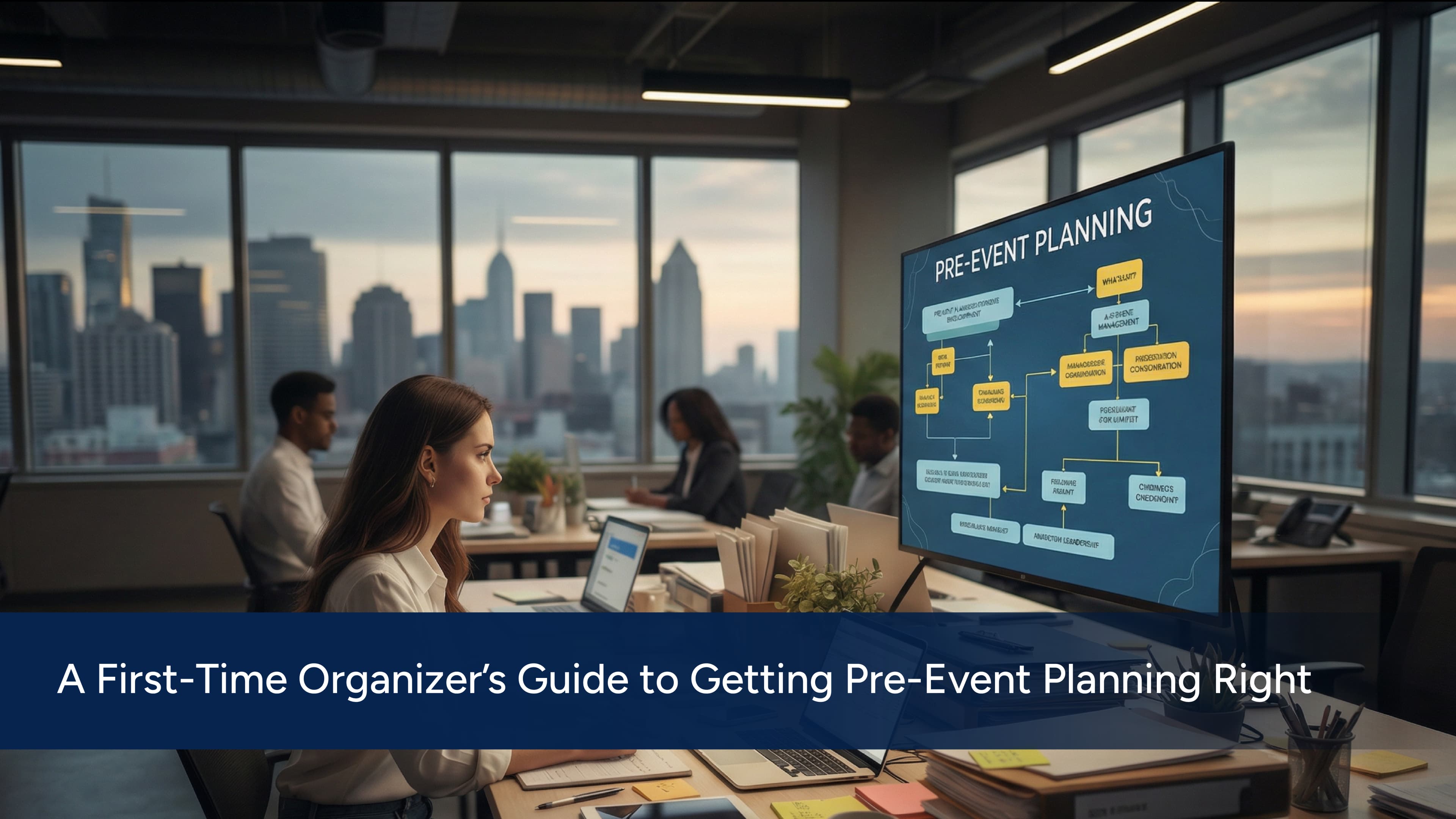
Successful events are rarely determined on event day. More often, their success is shaped weeks or even months earlier through effective pre-event planning. The decisions made before registrations open, tickets are sold, exhibitors are onboarded, and attendees arrive can have a significant impact on event execution, attendee experience, and overall event success.
For many first-time organizers, pre-event planning can seem like a series of administrative tasks: setting up ticketing, creating registration forms, sending confirmation emails, managing attendee data, and coordinating exhibitors.
But as event size grows, these seemingly small decisions become the foundation of your entire event operation. Poor planning can lead to registration issues, communication gaps, attendee confusion, and unnecessary operational stress.
The good news is that most event-day problems can be prevented long before the event begins. With the right pre-event planning strategy, organizers can streamline event registration, improve attendee management, simplify exhibitor coordination, and create a smoother experience for everyone involved.
In this guide, we'll explore the essential elements of pre-event planning and show how experienced organizers build systems, processes, and workflows that help events run efficiently from registration through execution.
What “Pre-Event Planning” Actually Means at Scale
Before getting into specifics, it’s useful to level-set what pre-event work really looks like when you’re organizing a large event for the first time.
At scale, pre-event planning isn’t about ticking off tasks. It’s about putting systems in place early so that decisions don’t need to be made repeatedly later under pressure.
Most large-scale event issues can be traced back to one of these pre-event areas:
Ticketing
Registration and data capture
Branding and trust signals
Pre-event communication
Exhibitor preparation
Attendee management
Each of these areas compounds quickly as attendance grows. If they’re loosely defined early, they create operational load later. If they’re designed intentionally upfront, execution becomes far calmer.
The sections below walk through each of these areas in the order most first-time organizers feel the pain - starting with ticketing, because that’s where control is either established or quietly lost.
Pre-Event Planning Checklist for Event Organizers
Use this pre-event planning checklist to ensure your event is organized, scalable, and ready for a smooth execution.
Event Strategy & Goals
☐ Define event objectives and success metrics
☐ Identify your target audience
☐ Determine event format (in-person, virtual, or hybrid)
☐ Establish event budget and contingency fund
☐ Create a detailed event planning timeline
Ticketing & Registration
☐ Set up ticket types and pricing strategy
☐ Configure early-bird, group discounts, and promo codes
☐ Create registration forms with required attendee information
☐ Test registration and payment workflows
☐ Set up ticket transfers, cancellations, and refund policies
☐ Enable QR code ticketing and digital passes
Venue & Logistics
☐ Confirm venue booking and event dates
☐ Review venue capacity and floor plans
☐ Arrange seating, signage, and networking areas
☐ Confirm internet, AV equipment, and power requirements
☐ Develop emergency and contingency plans
Speakers, Sponsors & Exhibitors
☐ Confirm speakers and session schedules
☐ Collect speaker bios, photos, and presentation details
☐ Finalize sponsorship agreements
☐ Onboard exhibitors and provide event guidelines
☐ Share exhibitor setup instructions and timelines
Event Agenda & Content
☐ Build and publish the event agenda
☐ Assign rooms and session locations
☐ Schedule networking sessions and breaks
☐ Review agenda flow to avoid attendee fatigue
☐ Prepare backup plans for speaker changes
Branding & Event Experience
☐ Customize registration pages and event branding
☐ Add logos, banners, and sponsor visibility assets
☐ Review event website and landing pages
☐ Prepare attendee badges and event materials
☐ Test attendee-facing event apps and tools
Communication & Marketing
☐ Launch event marketing campaigns
☐ Schedule attendee confirmation emails
☐ Send event reminders and logistical updates
☐ Create speaker and sponsor promotional assets
☐ Set up WhatsApp, SMS, or email communication workflows
☐ Prepare FAQs and attendee support resources
Attendee Management
☐ Review attendee registrations and approvals
☐ Organize attendee segments and groups
☐ Set up attendee networking and matchmaking features
☐ Prepare check-in and registration desk workflows
☐ Train event staff and volunteers
Technology & Testing
☐ Test ticketing and registration systems
☐ Test attendee app and networking features
☐ Verify integrations and analytics tracking
☐ Conduct AV and livestream testing (if applicable)
☐ Perform a complete event-day rehearsal
Final Review (1-3 Days Before Event)
☐ Confirm all vendors and suppliers
☐ Verify attendee, speaker, sponsor, and exhibitor lists
☐ Share final instructions with attendees
☐ Review event-day roles and responsibilities
☐ Test check-in systems and badge printing
☐ Prepare backup contacts and emergency procedures
☐ Conduct final event readiness review
Ticketing Is Where Control Is Established (or Lost)
Ticketing is not just about selling access. It’s about defining rules.
Who is allowed in? What conditions apply? What happens when plans change?
First-time organizers often treat ticketing as a simple pricing problem. Experienced organizers treat it as a control system. This is where you decide how flexible or fragile your event operations will be.
For example, approval-based or hidden tickets aren’t edge features. They’re safeguards. They let you manage internal invites, VIPs, speakers, partners, or private groups without leaking access publicly. Group discounts and access codes aren’t just marketing levers either; they reduce manual coordination when teams or companies attend together.
Digital tickets with QR codes become critical once scale kicks in. Not because paper tickets are bad, but because digital tickets allow you to track, verify, and adapt in real time. When changes happen - and they always do - you don’t want to be reissuing PDFs or chasing spreadsheets.
Good ticketing systems also handle the boring but essential parts: tax invoices, refunds, cancellations, transfers. These are the things that consume hours when handled manually and seconds when handled properly.
This is why platforms like KonfHub treat ticketing as a foundational layer rather than a checkout screen. Not because of features, but because control early prevents chaos later.
Registration Is About Shaping Behavior, Not Just Collecting Data
Registration forms are one of the most underestimated parts of pre-event planning.
Most first-time organizers either ask for too little information and regret it later, or ask for too much and kill conversion upfront. The balance lies in conditional logic.
The best registration setups adapt based on who the attendee is and what they’ve selected. A speaker shouldn’t see the same form as a general attendee. An exhibitor contact doesn’t need the same questions as a student. Conditional forms allow you to keep the experience simple while still collecting what you actually need.
This also becomes the first place where expectations are set. Clear post-registration messages, redirects, and confirmations reduce follow-up emails dramatically. When attendees know what happens next, they stop asking.
KonfHub’s customizable registration flows are a good example of how this works in practice. The flexibility isn’t about customization for its own sake; it’s about reducing friction for everyone involved.
Branding Before the Event Is About Trust, Not Aesthetics
Branding during pre-event planning is often mistaken for “making things look nice.” In reality, it’s about credibility.
Attendees decide whether your event feels legitimate long before they arrive. Emails, tickets, invoices, and registration pages all act as trust signals. If these feel inconsistent or generic, uncertainty creeps in.
Using your own domain for communication, customizing email templates, placing your logo on tickets and invoices, and controlling post-registration messaging all contribute to a sense of legitimacy. These details matter even more for first-time events because attendees don’t have past experiences to rely on.
White-labeling features exist to remove doubt. When everything feels cohesive, attendees trust the process. When they trust the process, they’re more patient, more prepared, and less likely to flood your inbox.
Pre-Event Communication Is Where Most Problems Are Prevented
Most event-day issues are actually communication failures that happened earlier.
Attendees didn’t know where to go - They didn’t understand what their ticket included, they didn’t realize something required approval.
Pre-event communication isn’t about reminders alone. It’s about reducing uncertainty.
Multi-channel communication helps here, not because email is broken, but because attention is fragmented. Email works for detail. WhatsApp works for immediacy. Automated confirmations, schedule nudges, and logistical updates reduce last-minute panic.
The key is not volume, but clarity. Pre-approved templates, structured messaging, and predictable touchpoints ensure attendees feel informed without being overwhelmed.
This is where platforms that integrate communication into the event workflow - rather than treating it as an external task - quietly outperform ad-hoc setups.
Exhibitors Need Structure, Not Hand-Holding
If your event includes exhibitors, pre-event planning must account for them as a separate audience.
Exhibitors don’t want more emails. They want fewer questions and clearer systems.
When exhibitors have access to their own portal, with listings, team management, lead capture tools, and downloads, two things happen. First, they prepare better. Second, they stop relying on you for every small request.
White-labeled exhibitor portals also reinforce professionalism. Exhibitors are more likely to engage when the tools feel like an extension of your event, not a third-party workaround.
This shift - from organizer-managed to exhibitor-enabled - is one of the biggest differences between first-time events and mature ones.
Bonus Read: Post-Event Checklist: Turn Event Data Into Better Results
Attendee Management Is About Expecting Change
No matter how well you plan, attendees will change their minds.
Names will need updates, tickets will need transfers, refunds will be requested.
The question isn’t whether this will happen, but whether you’ve planned for it.
Bulk actions, advanced filters, QR-enabled attendee lists, and clean export options turn what could be a daily headache into a background task. When attendee management tools are intuitive, your team spends less time fixing issues and more time improving the experience.
KonfHub’s attendee management features are built around this reality: change is normal, and systems should absorb it quietly.
Pre-Event Planning Is What Makes the Event Feel Effortless
Attendees rarely notice good pre-event planning. They only notice its absence.
When tickets work.
When emails make sense.
When exhibitors are prepared.
When no one is confused before arrival.
That’s not luck, that's structure.
If you’re organizing a large-scale event for the first time, resist the urge to treat pre-event planning as setup work you’ll “get through.” It’s the work that determines whether execution feels calm or chaotic.
Platforms like KonfHub exist to support this stage not by selling features, but by encoding lessons learned from thousands of events into systems that hold up under pressure.
And when pre-event planning is done right, the event itself finally gets to be what it should be - the easy part.
Conclusion
Successful events don't begin when attendees arrive. They begin long before event day through effective pre-event planning. The decisions made during ticketing, registration, attendee management, exhibitor coordination, branding, and communication create the foundation for a smooth and successful event experience.
A well-structured pre-event planning process helps organizers reduce operational challenges, improve attendee satisfaction, and prevent many of the issues that typically arise during event execution. By putting the right systems, workflows, and communication strategies in place early, organizers can focus less on troubleshooting and more on delivering a memorable event.
Whether you're planning a conference, trade show, corporate event, or community gathering, investing time in pre-event planning is one of the most effective ways to improve event outcomes. The more structure you create before the event, the easier it becomes to manage registrations, support attendees, coordinate exhibitors, and execute confidently on event day.
If you're looking to simplify event registration, attendee management, exhibitor coordination, and event communication, book a demo with KonfHub and discover how the right event management platform can make pre-event planning more efficient and scalable.
Frequently Asked Questions (FAQs)
What is pre-event planning?
Pre-event planning is the process of preparing all the essential elements of an event before it takes place, including ticketing, registration, attendee management, communication, logistics, exhibitor coordination, and event marketing.
Why is pre-event planning important for event success?
Effective pre-event planning helps organizers reduce operational risks, improve attendee experiences, streamline event execution, and prevent last-minute challenges that can affect event success.
What should be included in a pre-event planning checklist?
A comprehensive pre-event planning checklist should include event goals, ticketing setup, registration forms, venue preparation, attendee communication, exhibitor management, speaker coordination, event marketing, and technology testing.
How far in advance should organizers start pre-event planning?
The timeline depends on event size and complexity, but most conferences, trade shows, and large-scale events benefit from starting pre-event planning at least 3 to 12 months before the event date.
How does attendee management fit into pre-event planning?
Attendee management is a critical part of pre-event planning because it helps organizers track registrations, manage ticket transfers, handle approvals, communicate updates, and create a smoother attendee experience before event day.
Why is event registration important during pre-event planning?
A well-designed event registration process helps organizers collect the right attendee information, improve registration conversion rates, reduce support requests, and set clear expectations before the event begins.
How can organizers improve pre-event communication?
Organizers can improve pre-event communication by sending timely confirmations, reminders, event updates, agenda announcements, and logistical information through email, SMS, or messaging platforms.
How can event management platforms simplify pre-event planning?
Modern event management platforms help streamline pre-event planning by centralizing ticketing, registration, attendee management, communication, exhibitor coordination, analytics, and event workflows in a single system.