
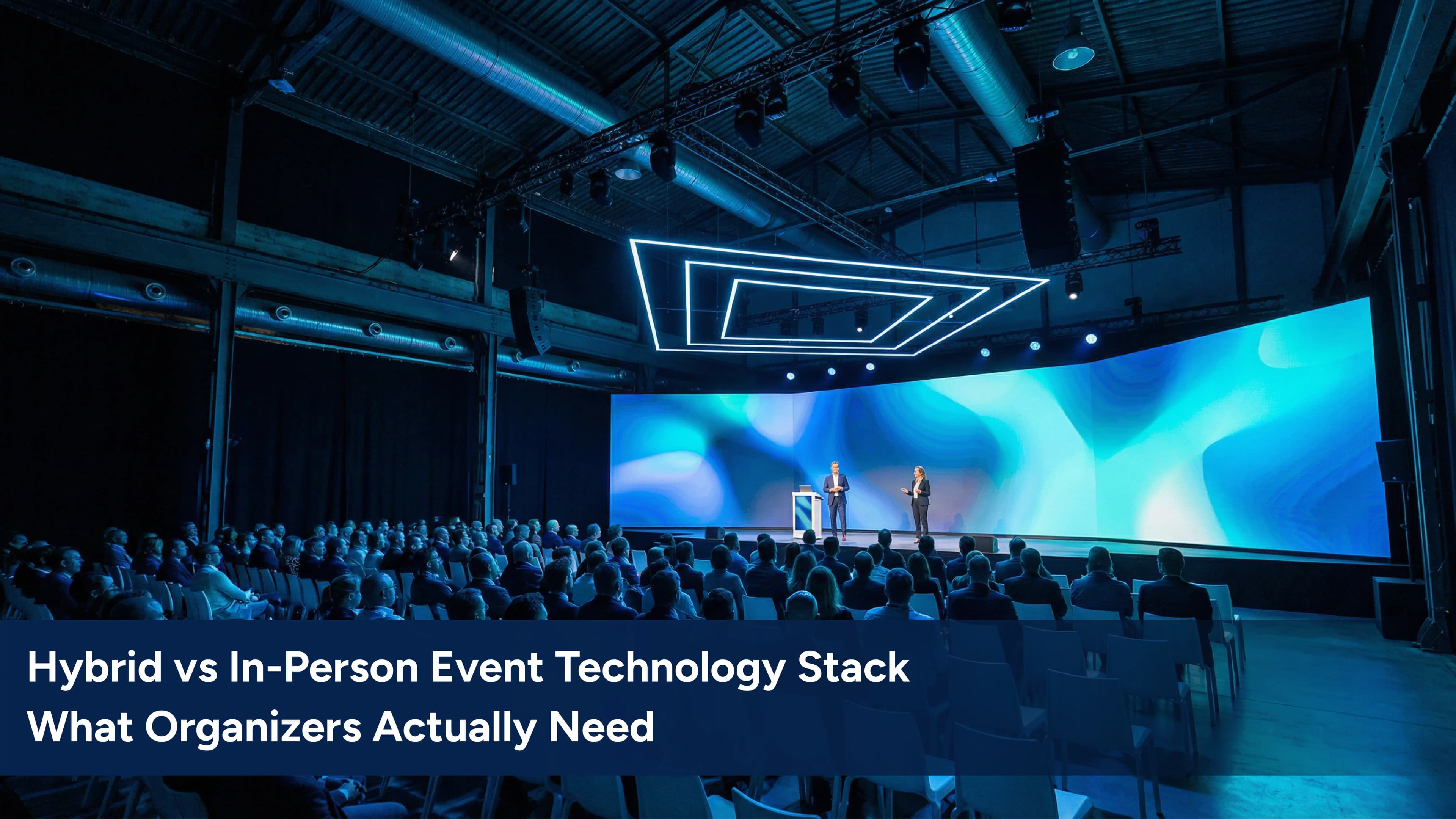
Hybrid vs In-Person Event Technology Stack: What Organizers Actually Need
For a while, the conversation around hybrid events was loud, urgent, and slightly panicked.
Everyone needed to “go hybrid.” Platforms rushed to bolt streaming onto registration. Tools multiplied. Stacks grew heavier. And organizers were told they needed entirely different technology depending on whether an event was in-person or hybrid.
That phase is over.
Today, most organizers are no longer asking whether to run hybrid or in-person events. They’re asking a more practical question:
What technology do we actually need to run this well, without overengineering it?
The answer is not two different stacks. It’s one coherent system that behaves differently depending on context.
The Mistake: Treating Hybrid and In-Person as Separate Categories
One of the biggest conceptual mistakes organizers still make is thinking of hybrid and in-person events as fundamentally different species.
They’re not.
What changes between them is where attendees are located, not what they need.
Both audiences want:
a clear sense of what’s happening
easy access to sessions
relevant networking
minimal friction
reliable information in the moment
When technology is chosen based on format labels instead of attendee needs, stacks get bloated fast. Organizers end up managing parallel tools that don’t talk to each other, creating more work instead of less.
The smarter approach is to start with a core event system, then extend it where needed.
The Core Stack Is Smaller Than Most Teams Think
Strip away the hype and most events, regardless of format, rely on the same foundational layers.
You need a way to manage registrations and tickets. You need a reliable method to identify attendees. You need a channel to communicate updates. You need visibility into who showed up, what they attended, and how they engaged.
That’s the core.
Hybrid events don’t require a new foundation. They require additional surfaces where the same information is exposed to different audiences.
When teams buy separate tools for “virtual” and “physical” without aligning the core data layer, problems show up immediately. Attendee records drift. Engagement data fragments. Reporting becomes a reconciliation exercise instead of an insight tool.
Where In-Person Events Actually Break Without the Right Tech
Purely in-person events tend to fail quietly.
Not catastrophically, but through friction that accumulates across the day.
Check-in takes longer than expected. Attendees miss sessions because they didn’t know a room changed. Networking feels shallow because people don’t know who else is there. Organizers finish the event without confidence in attendance numbers or engagement quality.
None of this looks dramatic. It just feels inefficient.
This is where tools like attendee apps, check-in systems, and session tracking matter. Not because they’re flashy, but because they reduce the number of micro-decisions attendees and staff have to make.
An in-person event with the right tech stack feels calm. One without it feels like constant improvisation.
Hybrid Events Fail for the Opposite Reason
Hybrid events don’t usually fail due to lack of tools. They fail due to too many disconnected ones.
Streaming works. Registration works. Networking exists somewhere. Analytics live elsewhere. Attendees jump between links, emails, and platforms. Organizers lose a single view of what’s happening.
The result is a fragmented experience where:
virtual attendees feel like second-class participants
speakers don’t know who they’re talking to
sponsors struggle to measure value
organizers can’t connect engagement across formats
The problem isn’t hybrid complexity, it’s architectural inconsistency.
Hybrid events need the same thing in-person events need, just exposed across more touchpoints.
The Real Differentiator: How Information Moves During the Event
Technology choices matter most during the event, not before or after.
This is when things change in real time. Sessions run late. Rooms fill up. Speakers swap slots. Attendees move unpredictably.
In these moments, the question isn’t “do we have a streaming platform?” It’s “can we update everyone, everywhere, without chaos?”
The most effective stacks have a single source of truth that feeds:
the attendee app
check-in and access control
session agendas
live updates and notifications
post-event analytics
When information moves cleanly through the system, both in-person and virtual audiences stay aligned.
When it doesn’t, confusion multiplies fast.
Networking Is Where Hybrid vs In-Person Differences Actually Matter
If there’s one area where format truly changes requirements, it’s networking.
In-person networking relies heavily on proximity and chance. Virtual networking relies on structure and intent. Hybrid networking needs to bridge the two without forcing them into the same experience.
This is where many platforms overpromise.
Good hybrid networking doesn’t try to replicate hallway conversations online. It helps people identify relevant connections, initiate conversations, and continue them beyond the session.
That’s why features like AI-powered matchmaking, attendee profiles, and integrated messaging matter more than virtual “lounges” or gimmicks.
Networking technology should reduce awkwardness, not simulate physical presence.
Why Analytics Should Be Stack-First, Not Add-On
One of the clearest signs of a fragmented stack is how analytics are handled.
When engagement data is pulled from five different tools after the event, reporting becomes slow and unreliable. Organizers end up with numbers they don’t fully trust.
A well-designed stack captures engagement as a byproduct of normal usage. Check-ins, session joins, interactions, and networking activity all flow into the same dataset.
This matters more for hybrid events, but it benefits in-person events just as much. The moment you want to compare formats, sponsors, or editions, clean analytics stop being optional.
What Organizers Actually Need to Decide
The most productive way to approach stack decisions isn’t “hybrid vs in-person.”
It’s asking:
How many systems will staff actively use on event day?
How many places will attendees need to check for information?
How many times will data need to be reconciled later?
Every extra tool increases cognitive load. Every disconnected system increases risk.
The best stacks feel boring during planning and invisible during execution. They don’t impress in demos. They hold up when things change.
How KonfHub Fits Into a Unified Stack Approach
KonfHub is designed around the idea that events aren’t formats, they’re workflows.
Registration, check-in, attendee apps, networking, exhibitor engagement, and analytics all sit on the same data foundation. Whether an attendee is onsite or remote, they’re interacting with the same system, just through different interfaces.
This reduces fragmentation without forcing organizers into a one-size-fits-all experience.
Hybrid events get flexibility. In-person events get structure. Organizers get clarity.
Closing Thought
The hybrid vs in-person debate is largely settled.
What matters now is whether your technology stack simplifies decision-making or multiplies it.
If your tools help everyone focus on the event instead of the infrastructure, you’re on the right path. If they require constant explanation, coordination, and reconciliation, the format isn’t the problem. The stack is.