Events bring together people who share an interest in a particular industry, product, or solution. For businesses, this creates an opportunity to meet potential customers, understand their needs, and build relationships that can eventually lead to sales. However, collecting business cards or scanning attendee badges is only the beginning. The real value lies in identifying the right prospects and knowing how to follow up with them.
A well-planned event lead capture process helps businesses turn event interactions into meaningful sales opportunities. Whether you're exhibiting at a trade show, sponsoring an industry conference, or hosting your own event, having a clear strategy ensures that valuable conversations don't end when the event does.
What Is Event Lead Capture and Why Is It Important?
Event lead capture is the process of collecting contact information and relevant details from potential customers during an event. This information may include names, email addresses, company details, job roles, product interests, and other details that help sales teams understand each prospect.
Unlike general event lead generation, which focuses on attracting potential customers and creating interest, lead capture concentrates on collecting information from those prospects so your team can continue the conversation.
For example, a software company exhibiting at a technology conference might meet 100 attendees. Some may be casually exploring solutions, while others may be actively looking for a product to purchase. Capturing relevant details helps the company distinguish between these groups.
An effective process helps businesses:
- Make better use of event investments: Identify which interactions are likely to generate business.
- Understand potential customers: Learn about their needs, interests, and challenges.
- Improve follow-ups: Give sales teams the information they need to start relevant conversations.
- Measure event performance: Connect event participation with qualified leads, sales opportunities, and revenue.
Without a structured approach, even promising conversations can be forgotten or lost among hundreds of contacts.
How to Capture Leads at Events
Knowing how to capture leads at events starts with choosing a process that suits your event format and audience. Here are some practical approaches.
1. Use Digital Registration and Lead Forms
Digital forms make it easier to collect consistent information from attendees. Depending on your goals, you can capture contact details, company names, job titles, and areas of interest.
Keep forms short. Asking too many questions can discourage people from completing them, especially when they're visiting multiple booths or attending back-to-back sessions.
2. Scan Attendee Badges or QR Codes
At trade shows and conferences, badge scanning and QR codes can speed up lead collection. Instead of manually entering contact details, exhibitors can scan an attendee's badge or QR code and retrieve the available information through the Lead capture app.
This approach is particularly useful when booth traffic is high and your team needs to speak with many visitors in a limited time.
3. Encourage Attendees to Share Their Interests
Contact information alone doesn't tell you whether someone is a potential customer. Include a simple question about what the attendee is looking for, such as a product demonstration, pricing information, or a future consultation.
This small addition makes subsequent event lead qualification much easier.
4. Capture Leads During Sessions and Networking
Not every valuable prospect visits an exhibition booth. Conferences, workshops, panel discussions, and networking sessions can also generate useful connections.
Encourage attendees to connect through event networking tools, QR codes, or dedicated forms. Make sure your approach is transparent and that people understand how their information will be used.
How to Qualify and Prioritize Event Leads
Capturing a large number of contacts may look impressive, but lead quality matters more than volume. Event lead qualification helps your team determine which prospects are most likely to become customers.
Start by assessing leads against a few practical criteria.
- Interest: Did the person ask about pricing, request a demo, or enquire about a specific product?
- Fit: Does their company, industry, or role match your ideal customer profile?
- Buying readiness: Are they researching options, comparing vendors, or ready to make a decision?
- Timeline: Do they intend to purchase soon, or are they exploring possibilities for the future?
Based on these details, divide leads into priority groups.
Hot leads: These prospects have a clear need, match your target audience, and are ready for a sales conversation. Contact them as soon as possible after the event.
Warm leads: These attendees have shown interest but need more information or time to make a decision. Share relevant resources, case studies, or product demonstrations.
Cold leads: These contacts may be relevant to your business but have no immediate buying intent. Add them to appropriate, permission-based marketing campaigns where suitable.
You can also use a simple lead-scoring system. Assign points for factors such as purchase intent, company fit, and engagement level. This gives sales teams a consistent way to prioritize follow-ups rather than relying on memory or personal judgment.
Event Lead Capture Methods and Tools
The right event lead capture strategies depend on your audience, event size, and business objectives. A small networking meetup may need only a digital form, while a large trade show may require a more comprehensive system.
Common methods include:
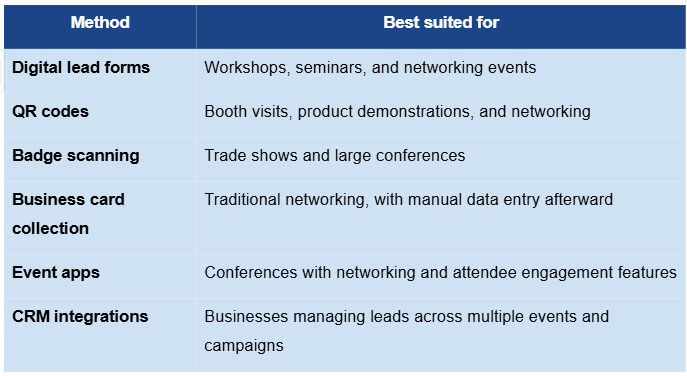
For larger events, event lead capture software can simplify data collection and reduce manual work. Depending on the platform, features may include badge scanning, custom questions, lead notes, qualification fields, and CRM integrations.
An effective event lead capture system should also make information accessible to the right team members. If contacts are scattered across spreadsheets, paper forms, and individual phones, following up becomes unnecessarily difficult.
For trade show lead capture and exhibitor lead capture, prioritize speed, accurate data collection, and the ability to record notes immediately after a conversation. For conference lead generation, networking features and session engagement may be equally important.
Before selecting a tool, consider how it handles event attendee data, whether it works reliably at your venue, and how easily information can be exported or transferred to your existing systems.
How to Turn Event Leads Into Sales Opportunities
Collecting contact details is useful only when your team acts on them. A clear follow-up process helps maintain the momentum created during an event.
- Follow up while the conversation is still fresh.
Reach out to high-priority leads within 24–48 hours where practical. Refer to the conversation you had, the product they asked about, or the problem they wanted to solve. A specific message feels more relevant than a generic sales email. - Personalize your communication.
Avoid sending the same message to every attendee. Someone who requested a product demo should receive different communication from someone who downloaded a resource or casually visited your booth. - Share something useful.
A product guide, relevant case study, recorded presentation, or answer to a question raised during the event can give prospects a reason to continue the conversation. - Assign ownership.
Every qualified lead should have a clear next step and a team member responsible for it. This prevents promising opportunities from sitting untouched in a shared spreadsheet. - Track progress in your CRM.
Update each lead's status as they move through the sales process. Your team should be able to see whether a contact has been approached, responded, booked a meeting, or progressed to an opportunity.
Effective event lead management connects the initial interaction to the wider sales process, helping teams understand which event contacts eventually become customers.
How to Measure and Improve Event Lead Capture Performance
Tracking the right metrics helps you understand whether your approach is producing meaningful results. Start with a few indicators that connect lead collection to business outcomes.
- Total leads captured: The number of contacts collected during the event.
- Lead qualification rate: The percentage of captured leads that meet your qualification criteria.
- Cost per lead: Total event expenditure divided by the number of leads captured.
- Follow-up rate: The percentage of leads contacted after the event.
- Conversion rate: The percentage of leads that progress to a defined outcome, such as a sales-qualified opportunity or customer.
- Revenue generated: The revenue attributed to event leads, where reliable attribution is available.
For example, an event that generates 200 contacts but only five qualified opportunities may be less valuable than one that produces 60 contacts and 20 strong prospects.
Use event lead tracking to identify where leads come from, which activities generate the most interest, and how different lead groups progress after the event.
Review these findings with your marketing and sales teams. If leads are relevant but rarely respond, your follow-up may need improvement. If many contacts are unqualified, revisit your targeting, booth messaging, or lead capture questions.
Over time, these adjustments can improve lead quality and help you make better decisions about future events.
Conclusion
Successful event lead capture involves more than collecting names and email addresses. It requires a consistent process for recording useful information, identifying promising prospects, and following up with the right message at the right time.
Choose tools that suit your event, train your team to ask relevant questions, and establish clear criteria for prioritizing leads. Most importantly, connect your lead capture process with your sales and marketing workflows.
When every event interaction has a clear next step, your business is better positioned to turn conversations into lasting customer relationships and measurable growth.
Frequently Asked Questions
- What is event lead capture?
Event lead capture is the process of collecting contact details and relevant information from potential customers at events. It helps businesses identify prospects, understand their interests, and create opportunities for future sales. - How do you capture leads at an event?
You can capture leads at an event using digital forms, QR codes, attendee badge scanning, event apps, and business card collection. Asking attendees about their interests and requirements also helps you gather useful information for follow-ups. - What is the best way to capture event leads?
The best method depends on your event format and audience. Digital forms, QR codes, and badge scanning are effective options for collecting information quickly. For larger events, event lead capture software can help organize contacts, record notes, and simplify follow-ups. - How do you qualify leads at an event?
Qualify leads by evaluating their interest in your product, business requirements, company fit, budget, and purchase timeline. Categorizing prospects as hot, warm, or cold leads helps sales teams prioritize follow-ups and focus on the most promising opportunities. - What information should you collect from event leads?
Collect essential details such as the attendee's name, email address, company, job title, and areas of interest. Depending on your goals, you can also record their specific requirements, purchase timeline, and conversation notes to personalize future communication. - How do you follow up with leads after an event?
Follow up with high-priority leads within 24–48 hours where possible. Personalize your message by referring to your conversation and sharing relevant resources, product information, or demo opportunities. Assign clear next steps and track responses to keep potential sales opportunities moving forward. - How do you measure event lead capture success?
Measure event lead capture success using metrics such as total leads captured, lead qualification rate, cost per lead, follow-up rate, conversion rate, and revenue generated. Reviewing these metrics helps you identify effective strategies and improve the results of future events.
About the author
KonfHub is an AI-powered, GDPR-compliant platform for seamless ticketing, secure attendee management, and smooth event operations. Say goodbye to complexity and hello to seamless, powerful event management!
Comments
Join the discussionNo comments yet. Be the first to comment.